
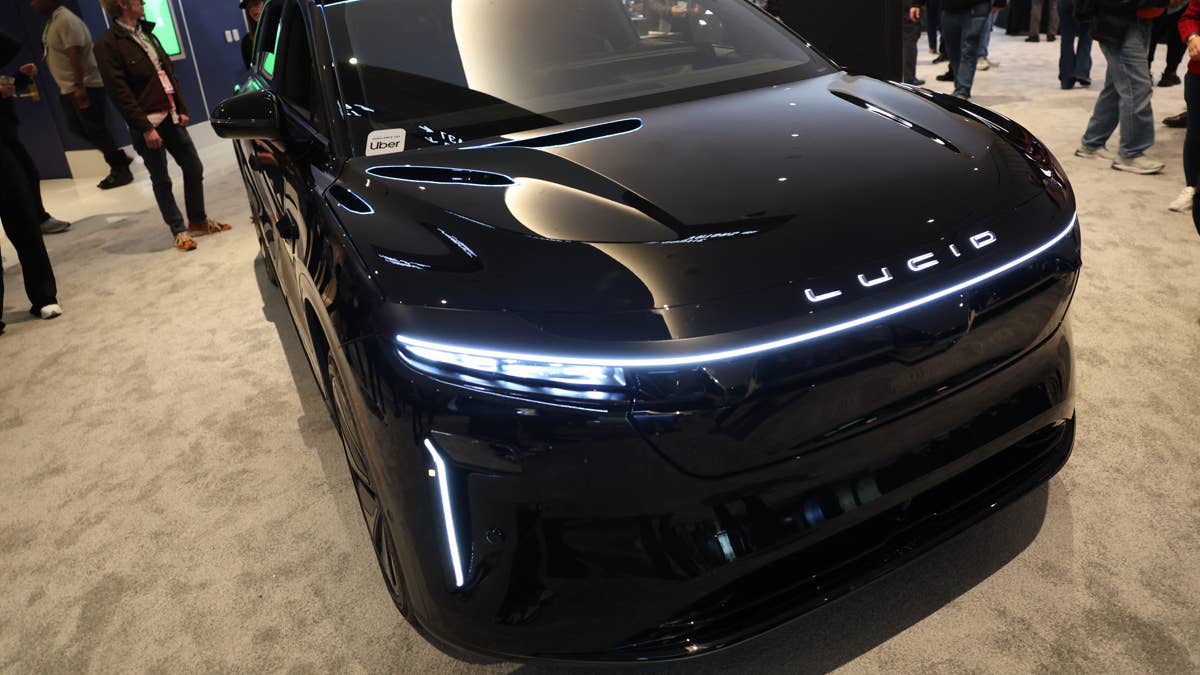
Electric vehicles were supposed to be the future of the auto industry. For one Saudi-backed automaker, the future is starting to look a lot like a balance sheet crisis.
Lucid Group has burned through billions of dollars in cash, missed delivery targets, and just replaced most of its executive team.
Now bankruptcy chatter is following the stock everywhere it goes.
Shares have fallen roughly 99% from their peak, and the company’s own numbers explain why Wall Street keeps asking the same uncomfortable question: Can Lucid (LCID) survive long enough to become profitable?
Lucid stock plunges on bankruptcy speculation
On July 14, LCID stock fell more than 40% at one point, and trading was halted several times for volatility, according to CNBC. Shares closed the day down 16%, at $4.62.
CNBC explained:
- The selloff followed a report from EV-focused outlet Electric Vehicles, which said Lucid was weighing options that included going private or filing for Chapter 11 bankruptcy protection.
- The outlet said Lucid had hired consulting firm AlixPartners to study those options and report back to the board, and that AlixPartners had also pushed for deeper restructuring in the United States and Europe with a sharper focus on the Gravity SUV.
- AlixPartners declined to comment, while Lucid pushed back hard, emphasizing that the rumors were “completely false” and that the company has enough cash to fund operations well into next year.
- Lucid also said no special board committee had been formed to study those scenarios, and that AlixPartners was helping with execution, not recommending bankruptcy.
Whether or not those specific rumors are accurate, the broader financial picture at Lucid gives investors plenty to worry about on its own.
The numbers behind worry over Lucid’s future
Lucid is not close to making money, and the gap between revenue and costs is enormous. In the first quarter of 2026, the company brought in $282.5 million in revenue but spent $594.2 million just on the cost of building its vehicles.
That left a gross profit margin of negative 110.4%, meaning Lucid loses more than a dollar on production costs for every dollar of vehicles it sells. Its gross margins in the prior quarter were -80.7%.
Add in $304.2 million of selling and administrative costs and $335.7 million of research and development spending, and Lucid posted an operating loss of $989.5 million in a single quarter. Net loss for the period came in at roughly $1.03 billion.
Cash is draining fast, too.
Lucid held $700.4 million in cash and cash equivalents as of the most recent quarter, down from $997.8 million just three months earlier and sharply down from $1.85 billion a year ago. Total liabilities stood at $5.45 billion against total assets of $7.48 billion.
Forward estimates compiled by TIKR.com show the losses are expected to continue for years.
Analysts project EBITDA losses of roughly $2.74 billion in 2026 and $1.76 billion in 2027, with free cash flow staying negative through at least 2030. Lucid is not expected to reach positive EBITDA until around 2030, per those estimates.
A leadership shakeup hits Lucid
Lucid’s response has been to overhaul its leadership.
On July 2, the company announced a wave of executive changes under CEO Silvio Napoli meant to “simplify the company’s structure, sharpen accountability and improve execution,” according to a company statement.
The company brought in a new chief financial officer, chief technology officer, chief customer officer, and chief transformation officer, while also creating a new business unit for autonomy and robotaxi technology led by a newly named president of Lucid Technologies.
More Automotive:
- Uber changes key rule for drivers amid rider safety lawsuits
- Volkswagen may cut 100,000 jobs in brutal reset
- Honda CEO withstands investor backlash after $9B EV misstep
Longtime CFO Taoufiq Boussaid is departing after a handover period, according to the statement.
Napoli stated:
“The caliber of leaders who are joining the Lucid leadership team is a testament to the inherent value of our business and to the exciting prospects ahead of us. We are building a new team who will transform the company.”
That same quarter, Lucid missed Wall Street’s expectations for second quarter deliveries, CNBC reported.
The company also disclosed it was cutting 18% of its U.S. workforce last month as part of a broader cost-saving plan, and it has been dealing with softer-than-expected EV demand nationwide following the elimination of the $7,500 federal EV tax credit, according to CNBC.
Back in May, on Lucid’s first quarter earnings call, executives suspended production guidance entirely while Napoli reviewed the business.
Interim CEO Marc Winterhoff told analysts the company was working to reduce an “elevated inventory” of vehicles, and CFO Boussaid said Lucid’s liquidity, including a recent capital raise, extended its runway into the second half of 2027 but stopped short of detailing exact cash burn projections.
Patrick T. Fallon / Getty Images)
What it means for LCID stock investors
Lucid insists it has the liquidity to keep operating and has denied any active bankruptcy planning.
But a company burning through roughly $3 billion to $4 billion a year, with gross margins deeply negative and years of losses still projected ahead, is walking a narrow path.
The stock’s collapse reflects that reality. Investors watching Lucid now are essentially betting that a brand new leadership team can turn around production, control costs, and reach the Midsize vehicle ramp in 2027 before the cash runs out.